Active Mobility Rules for Retailers

Under the Active Mobility Act 2017, retailers of Active Mobility Devices (AMDs), such as three-wheeled pedal cycles, recumbents, Personal Mobility Devices (PMDs), Power-Assisted Bicycles (PABs) and Personal Mobility Aids (PMAs) are required to comply with the following requirements:

  • Display the prescribed warning notices 
  • Not keep non-compliant PABs or e-scooters that are not UL2272 certified
  • Not display, advertise or sell non-compliant AMDs for use on public paths and roads (where applicable)
  • Not alter or modify devices to be non-compliant

From 1 June 2026, retailers can only display, advertise or sell registered mobility scooters and mobility scooter equivalents. More details can be found below.

From the second quarter of 2027, LTA will implement new regulations on the sale and advertisement of active mobility devices, as well as lithium mobility device batteries. Refer to the Industry Circular (PDF, 107kB)  for more information.

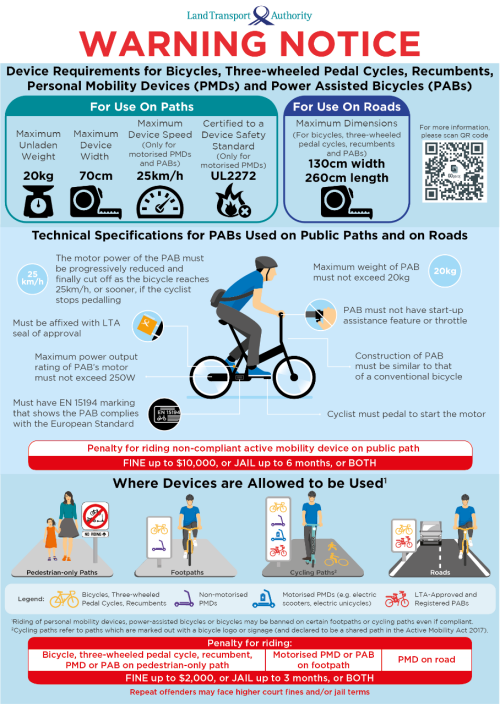
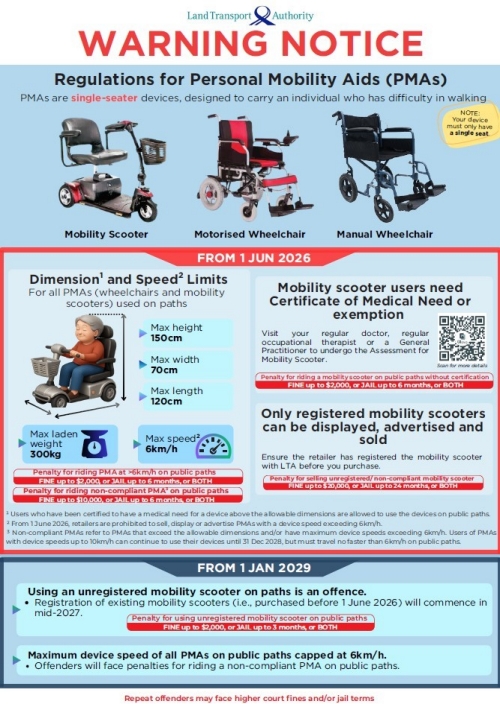
Retailers must display the below warning notice(s) for selling bicycles, three-wheeled pedal cycles, recumbents, personal mobility devices and power-assisted bicycles (PDF, 599kb) and/or personal mobility aids (PDF, 744kb). The notice must be no smaller than 29.7cm x 42cm, printed indelibly in colour with a minimum resolution of 300 dpi, and displayed prominently at or near any point of sale or payment.

It is an offence to display, advertise for sale, or sell non-compliant motorised AMDs, as well as to keep e-scooters that are not UL2272 certified or PABs that are non-compliant.

If found guilty, offenders may face a fine of up to $10,000 and/or imprisonment up to 12 months for the first offence. Please refer to the following links for more information on the rules and regulations governing dealings in the specified class of AMDs:

Warning Notice

Figure 1: Warning notice for bicycles, three-wheeled pedal cycles, recumbents, PMDs and PABs

Warning Notice PMA

Figure 2: Warning notice for PMAs

The e-scooter inspection regime was introduced in 2020 to ensure that e-scooters comply with the device criteria for use on public paths. In 2021, the import control regime was implemented to ensure that only compliant e-scooters are imported into Singapore.

Only new e-scooters meant for sale or let for hire by retailers/companies are allowed to be registered with LTA after passing Registration Inspection. Individuals who are not retailers/companies will not be able to register e-scooters with LTA.
 

Registration Inspection (RI) of New E-scooters

Step 1: Check UL2272 whitelist

Before importing an e-scooter, check if the model of your e-scooter is listed by LTA as an UL2272 certified e-scooter (“UL2272 Model”) in the list of UL2272 Models (PDF, 1.3MB). Ensure that every device specification matches completely with the model you are intending to bring in.

If your e-scooter model is found on the list of UL2272 Models, you may proceed to Step 2.

If your e-scooter model is not found on the list, you are required to have the e-scooter model listed as a UL2272 Model first. This includes any variant models of recognised models (e.g. those with different maximum speed, battery capacity, or other technical specifications that affect the UL2272 certification). To request listing, please write in to LTA_escooter_insp@lta.gov.sg with the details listed in Table 1 (PDF, 14kB). Please ensure all information and documents are submitted to facilitate LTA’s assessment. Once LTA acknowledges and lists the model, you may proceed to Step 2 .

Step 2: Importing your e-scooter

You will need to apply for an Import Permit via TradeNet. Please refer to the Import Control Regime for PABs and Motorised PMDs for more information on the import procedures.

Step 3: Registering at E-scooter Inspection Centres

Registration can be conducted at the E-scooter Inspection Centres (EICs) listed in List of EIC locations (PDF, 134kB). Please schedule an appointment directly with your chosen centre.

Prior to your appointment, complete and email the RI application form (PDF, 219kB) and supporting document(s) to the EIC.

Only e-scooters that have passed the RI will be registered. After passing the RI, EIC personnel will affix the LTA-issued Registration Mark.

Retailers are required to fabricate and affix the Identification Mark bearing the assigned registration number no later than 3 calendar days after the registration of the device.

Step 4: Transferring of e-scooter ownership to customer

Upon sale of registered e-scooters, retailers must ensure that the transfer of ownership to buyers is completed via OneMotoring. Please visit OneMotoring for more information on the transfer of ownership procedures.
 

Periodic Inspection (PI) of Registered E-scooters

Registered e-scooters will be called up for Periodic Inspection every 2 years to ensure they remain compliant with LTA’s device criteria for use on public paths. The PI fee will be paid for by owners. E-scooters that do not pass inspection, or are not presented for inspection by the deadline, will be deregistered by LTA.

At a glance (what retailers must do)

  • Sell only compliant devices (speed and dimension limits apply).
  • From 1 June 2026: Retailers can only display, advertise or sell registered mobility scooters and mobility scooter equivalents.
  • Only whitelisted models tagged to its approved eligible entities (retailers) (PDF, 3.2MB) can be registered for sale.
  • Before sale: Check the buyer has a Certificate of Medical Need (or is exempted) via LTA’s OneMotoring website.
  • Ensure sale is completed with ownership transfer of the registered mobility scooter to the buyer.


Key dates

  • 20 April 2026: Applications to whitelist mobility scooter models begin.
  • 27 April 2026: AIC booking for registration appointments opens.
  • 4 May 2026: Registration of new mobility scooters begins.
  • 1 June 2026: New PMA rules take effect (including 6 km/h path speed limit and retailer sale/registration requirements).
  • Mid-2027: Registration for existing mobility scooters begins (details to be released).
  • 1 January 2029: All mobility scooters used on public paths must be registered; all PMAs must have maximum device speed not exceeding 6 km/h.


Whitelisting of Mobility Scooters with LTA

All mobility scooter retailers (i.e. businesses selling/ transferring the device to end users) are required to whitelist the mobility scooter before the device can be registered and sold.

Retailers may submit their applications for mobility scooter models to be whitelisted from 20 April 2026. For your application to be processed smoothly, please ensure that:

  • The device description (e.g. model no.) tallies with the product listed on HSA Class A database and product manual

If you are also the importer/ local manufacturer of the device, please ensure that:

If you are just the retailer (i.e. did not import/ manufacture the device), please ensure that:

  • The device has been listed on HSA’s Class A medical device database by the importer/ manufacturer you are purchasing the device from


A list of whitelisted mobility scooter models tagged to its approved eligible entities (retailers) can be found here (PDF, 3.2MB).

Registration and Sale of Mobility Scooters

Retailers must have the mobility scooters registered and tagged by LTA’s Authorised Inspection Centres (AICs) (PDF, 91kB) before they are sold. As part of the registration process, LTA’s AICs will check that the new mobility scooter meets device criteria (i.e., size dimensions, maximum speed of 6km/h), and affix the device with a Registration Mark and Identification Mark.

To book an appointment with the AICs, you may wish to visit VICOM’s website or contact STAI via email. Retailers are required to email the completed Mobility Scooter Registration Application Form (PDF, 3.9MB) to the preferred AIC when booking the appointment.

More details can be found on LTA’s OneMotoring website. Retailers with enquiries on whitelisting and registration-related issues may write in to LTA_PMA_Retailermatters@lta.gov.sg.

PABs are required to meet device requirements in order to be imported, used and sold locally. This includes compliance with the EN15194 standard. Since 2021, only EN15194:2017 compliant PABs can be approved, sealed and registered by the LTA-Authorised Inspection Centres (AICs). Retailers with queries on the EN15194:2017 standard may submit them at www.lta.gov.sg/feedback.

Regulations on the Sale and Advertisement of Active Mobility Devices and Batteries

LTA will introduce the new rules below, from the second quarter of 2027.

Regulations on online sale and advertising

Existing rules governing the sale and advertising of active mobility devices by retailers with physical shops will be extended to online dealings via channels such as standalone websites and online marketplace platforms. They include:

  1. Requirement for sellers to display warning notices when selling Power-Assisted Bicycles (PAB), e-scooters and mobility scooters. LTA will prescribe the format of the warning notices closer to the date of commencement of the new rules;
  2. Prohibition against advertising non-compliant active mobility devices;
  3. Prohibition against selling Personal Mobility Devices (PMDs) and motorised Personal Mobility Aids (PMAs) for use on roads; and
  4. Prohibition against selling non-compliant active mobility devices for use on public paths.


Tightening of advertisement restrictions

It would be an offence to:

  1. Make a false or misleading representation about an active mobility device’s compliance, model/type, lawful use, battery compatibility or component specifications when selling or advertising the product; or
  2. Advertise services to modify an active mobility device which would make the device non-compliant.


Restrictions on sale and advertisement of mobility device batteries

The following rules on the sale and advertisement of mobility device batteries (lithium batteries only) are as follows:

  1. Sellers of mobility device batteries must display a specification notice for each mobility device battery listed or offered for sale. The notice must state the device model or models compatible to the battery, the battery brand and model, if any, and the battery’s voltage and capacity. LTA will provide further details closer to the date of commencement of the new rules.
  2. It would also be an offence to perform any of the following:
         a.  advertise a non-compatible battery for use with an active mobility device;
         b.  sell a battery knowing that the buyer intends to fit it to an active mobility device that is not compatible with that battery; or
         c.  fit an active mobility device with a non-compatible battery.


What is a Compatible Battery?

For PMDs and PABs, a compatible battery is one that was fitted into and tested with that device model to meet the prescribed safety standards, or another battery of the same brand and model. 

For mobility scooters, a compatible battery is one that was originally installed by the manufacturer or endorsed by the manufacturer as suitable for use with the device, or another battery of the same brand and model.


Expanded coverage of display, advertisement and sale restrictions

Existing restrictions on the display, advertisement and sale of non-compliant devices will be extended to unregistered or unapproved devices. Specifically, it would be an offence to:

  1. Display an unapproved and unsealed PAB, an unregistered e-scooter, or an unregistered mobility scooter;
  2. Sell an unapproved and unsealed PAB, an unregistered e-scooter, or an unregistered mobility scooter; or
  3. Advertise an unapproved and unsealed PAB, an unregistered e-scooter, or an unregistered mobility scooter, unless the advertisement clearly states that the device stated in that advertisement or listing will be approved and sealed, or registered, as applicable, before it is delivered to the customer.


Powers to issue directions to sellers and online marketplace operators

LTA will have the powers to issue written directions requiring:

  1. Sellers to put up or correct a warning notice / specification notice, stop a sale, remove a sale listing, or correct a sale listing or advertisement or take reasonable measures to disable access in Singapore; and
  2. Online marketplace operators to provide LTA with information in relation to sellers on their platforms for the investigation or enforcement of active mobility offences.
Scroll To Top

Welcome to

LTA.GOV.SG


This quick tour will bring you through the key enhancements.

Use the links at the top navigation bar to help you find what you are looking for


Tutorial Menu Tutorial Menu Tutorial Menu

Jump straight into the popular pages that

are most relevant to you


Tutorial Popular Resources Tutorial Popular Resources Tutorial Popular Resources

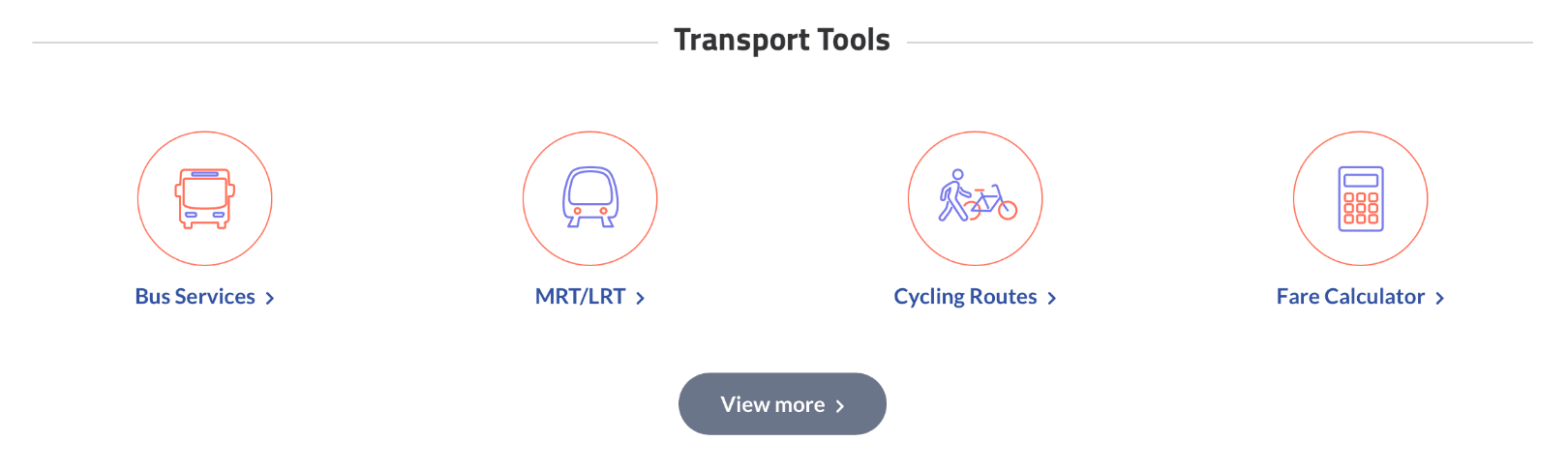
Taking a bus, train, or cycling to your

destination? Plan your routes and check

the fares using these tools!


Tutorial Transport Tools Tutorial Transport Tools Tutorial Transport Tools

Our latest featured projects are just a click away!


Tutorial Featured Projects Tutorial Featured Projects Tutorial Featured Projects

Start exploring

LTA.GOV.SG now!


Explore Now!