Personal Mobility Aids (PMAs) include manual wheelchairs, motorised wheelchairs and mobility scooters. They are designed and intended to carry an individual who is unable to walk or has difficulty walking.

Regulations for Personal Mobility Aids
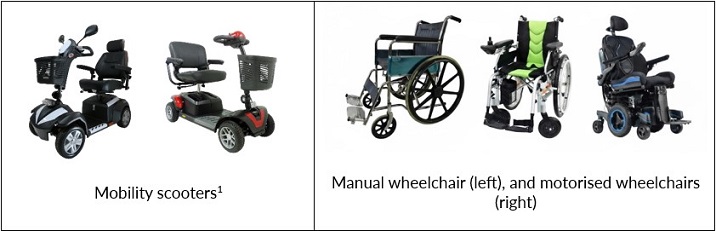
1 A mobility scooter must satisfy the following:
(a) Has 3 or more wheels and a single footboard supported by the wheels;
(b) Is steered by handlebars (including a delta tiller);
(c) Has only one seat behind the footboard (i.e. devices with multiple seats are not considered mobility scooters);
(d) Is designed to carry only one individual who is unable to walk or has difficulties walking; and
(e) Is propelled by a motor that forms part of the vehicle.
Know the differences between mobility scooters and their lookalikes (PDF, 366kB) and ensure you only purchase compliant active mobility devices.
The following regulations will take effect from 1 June 2026:
- All motorised PMAs must not go above 6km/h on paths. Existing motorised PMAs with maximum device speed of up to 10km/h can continue to be used until end-2028, but must travel no faster than 6km/h on paths.
- All PMAs used on public paths must comply with the following dimension restrictions (which currently apply on public transport):
- Width: 70cm
- Length: 120cm
- Height: 150cm (measured from the floor to the height of the PMA or the user’s head, whichever is higher)
- Laden Weight: 300kg (including the user)
- Users who require a PMA beyond the allowable dimensions must have their need certified by a healthcare professional through the Assessment for Mobility Scooter (AMS).
- Users of mobility scooters and its equivalents must obtain a Certificate of Medical Need through the AMS. Mobility scooter equivalents include manual wheelchairs with detachable motorised attachments steered by handlebars.
- Retailers can only display, advertise or sell registered mobility scooters and its equivalents. The devices must have maximum speeds not exceeding 6km/h, and be within the new device dimensions restrictions. Retailers are to submit mobility scooter models for whitelisting with LTA, and only models on the list of whitelisted mobility scooter models and their approved eligible entities (retailers) (PDF, 3.2MB) can be registered. More details on registration can be found below:
- [February 2026] Joint industry circular by LTA and HSA (PDF, 240kB)
- [April 2026] Industry circular by LTA (PDF, 241kB)
The following regulations will take effect from 1 January 2029:
- All mobility scooters used on public paths will need to be registered. Registration of existing mobility scooters will commence in mid-2027. More details will be released later.
- The maximum device speed of all PMAs must not exceed 6km/h. Users may wish to check with their device retailer directly to see if a speed adjustment can be done safely for their device so that they do not exceed the new speed limit.
Download the infographic to learn more about the New PMA Regulations (PDF, 1.8MB).
Who needs a Certificate of Medical Need?
From 1 June 2026, all users of mobility scooters and its equivalents1 will be required to obtain a Certificate of Medical Need, via the Assessment for Mobility Scooter (AMS), to use their devices on public paths. The following groups are exempted and do not require a certification:
- Seniors aged 70 and above; or
- Beneficiaries of subsidised mobility scooters from the Seniors’ Mobility and Enabling Fund (SMF) before 27 February 20262; or
- All existing and prospective beneficiaries of subsidised mobility scooters from the Assistive Technology Fund (ATF); or
- Past and future applicants of the Ministry of Health (MOH) disability schemes3, who have been assessed with Activities of Daily Living (ADL) needs in either ‘Mobility’ or ‘Transferring’ via the Functional Assessment Report (FAR) or Severe Disability Assessment (SDA).
Mobility scooter users who have completed their medical assessment can check their Certificate of Medical Need or Exemption Status through LTA's OneMotoring website. Please note that it can take up to one week after submission for your certification status to be reflected.
1 Users of mobility scooter equivalents, such as manual wheelchairs with detachable motorised attachments steered by handlebars are also required to have a valid Certificate of Medical Need.
2 All individuals who wish to apply for Government-subsidised mobility scooters under the SMF on or after 27 February 2026 will be required to undergo the AMS, which will replace other medical assessments previously required for SMF application. The Certificate of Medical Need under AMS will fulfil the medical assessment requirements under SMF.
3 These include the Pioneer Generation Disability Assistance Scheme, Home Caregiving Grant, Migrant Domestic Worker Levy Concession for Persons with Disabilities, CareShield Life, ElderFund, ElderShield, Interim Disability Assistance Programme for the Elderly (IDAPE) and MediSave Care.
How to obtain the Certificate of Medical Need?
From 27 February 2026, mobility scooter users can undergo the Assessment for Mobility Scooter (AMS) to obtain the Certificate of Medical Need.
Who can perform the AMS?
The AMS must be performed by a Singapore-registered doctor or Occupational Therapist (OT).
You may approach your regular doctor or regular OT to complete the AMS. If you do not have a regular doctor or OT, you may approach any General Practitioner (GP) that provides the service. View the list of GP clinics that conduct the AMS and their indicative charges (PDF, 260kB). You are advised to call them to confirm that they conduct the AMS and get the most updated fee information before making a trip to the clinic.
In some cases, a follow-up OT assessment may be required to assess your competency to operate a mobility scooter. View the list of OTs that conduct the competency assessment (PDF, 150kB). You are advised to call them to confirm that they conduct the competency assessment and get the most updated fee information before making a trip to the clinic.
What do I need to do before heading to the clinic?
Confirm with the clinic if they are able to conduct the AMS using the digital form and submit it to LTA for you.
If they are unable to do so, print a copy of the assessment form (PDF, 212kB) and bring it to the clinic.
How much will the AMS cost?
The charges for the AMS will vary depending on the complexity of the consultation. You may contact the clinics in advance to enquire about the cost.
In some cases, a follow-up OT assessment may be required to assess your competency to operate a mobility scooter.
What do I need to do after seeing the healthcare professional?
You must ensure your Certificate of Medical Need is submitted to LTA. This can either be done via (a) Digital Assessment Form (submitted by the healthcare professional to LTA) or (b) Hardcopy Assessment Form (that you must submit to LTA).
(a) Digital Assessment Form
If the healthcare professional has completed the digital assessment form, LTA will receive a copy of the submission and you need not submit anything else. If you would like to receive a digital copy of the form, you may provide the healthcare professional with your email address.
[Note: Healthcare professionals can find the link/QR code for the FormSG for submission to LTA in MOH’s Circular No. 73/2025, Annex A.]
(b) Hardcopy Assessment Form
If the healthcare professional has completed and signed the hardcopy assessment form (PDF, 212kB), you must submit it to LTA by following the steps below:
- Either scan or take a clear picture of the signed and completed hardcopy assessment form.
- Click on the link or scan the QR code below to access the FormSG link.
FormSG for submission of assessment form to LTA

- Fill in the details requested in the FormSG for submission to LTA. You will be prompted to upload a picture of the completed assessment form.
- Once you have submitted the form, an email acknowledgement will be sent to you.
How do I know if LTA has received my submission? Can I use my mobility scooter immediately after the healthcare professional has completed the AMS?
You can check LTA's OneMotoring website for your certification status, by keying in your NRIC and Date of Birth. It can take a week for your certification status to be reflected.
Once you have been certified by the healthcare professional under the AMS, you can use your mobility scooter immediately.
Frequently Asked Questions (FAQs)
Can I now apply for the Assistive Technology Fund (ATF) or the Senior Mobility Fund (SMF)-subsidised mobility scooters and skip the Assessment for Mobility Scooter (AMS)?
Applicants of the ATF will not be required to complete the Assessment for Mobility Scooter as they would need to undergo a similar medical need and device assessment for ATF. Applicants may wish to contact SGEnable for more information.
From 27 February 2026, all new SMF applicants will need to undergo the AMS as part of the application process. Applicants may wish to contact the Agency for Integrated Care for more information.
How can I check my certification status or exemption eligibility?
Users can check their certification status or exemption eligibility through LTA's OneMotoring website by keying in their NRIC and Date of Birth.
How will enforcement officers check if I have a Certificate of Medical Need?
LTA will maintain records of those who are certified to need a mobility scooter. Enforcement officers will request for the user’s particulars to check the user’s status. Alternatively, the user may also furnish a copy of the hardcopy certification form to the enforcement officer if they have it on hand.
I need a larger Personal Mobility Aid (PMA) due to medical needs. Can I get certified for an oversized device?
You can use an oversized device on paths if you are certified by a healthcare professional to require an oversized device, through the Assessment for Mobility Scooter.
However, you will not be able to use the oversized PMA on public transport due to safety and load considerations on trains and buses.
How can seniors 70 years and above be exempted to use an oversized device?
Seniors aged 70 years and above who require a device larger than the allowable dimensions must have proof of need for an oversized device due to medical needs. This can be done by undergoing the AMS or providing LTA with a doctor’s memo.
Do we determine the age of the senior by his/her year of birth or date of birth?
We will determine the age of the senior by his/her year of birth.
For all other queries, please write to LTA_PMA_Feedback@lta.gov.sg.
Registration of Mobility Scooters
All mobility scooters and its equivalents, including manual wheelchairs with motorised attachments, used on public paths will need to be registered by 1 January 2029.
The registration requirement will be rolled out in two phases:
Phase 1 (From 1 June 2026)
From 1 June 2026, all mobility scooters sold by retailers will need to be registered. Retailers are to submit mobility scooter models for whitelisting with LTA, and only whitelisted models tagged to retailers can be registered. View the details on retailer requirements.
Retailers must have the mobility scooters registered and tagged by LTA’s Authorised Inspection Centres (AICs) before they are sold. As part of the registration process, LTA’s AICs will check that the new mobility scooter meets device criteria (i.e., size dimensions, maximum speed of 6km/h), and affix the device with a Registration Mark and Identification Mark.
Before the sale of the mobility scooter, retailers will check via OneMotoring that the prospective owner has a Certificate of Medical Need, or is exempted from the requirement. The sale is completed only after the successful transfer of ownership of the registered mobility scooter from the retailer to the prospective owner.
Phase 2 (From Mid-2027)
To facilitate the registration of existing mobility scooters and minimise inconvenience to existing users, from mid-2027, LTA will deploy roving stations at community touchpoints to facilitate registration. LTA/LTA’s appointed vendor will conduct compliance checks on the device and user before registration.
Further details on the registration requirements for existing device users and process will be shared at a later date.
In the meantime, if you would like to register your interest in registering your device, please submit your details here. We will contact you once registration opens and provide information on the available registration stations.