Stay safe and keep moving regardless of age!


Seniors First: Staying Safe On Public Transport
Posted on
| 31 Oct 2025
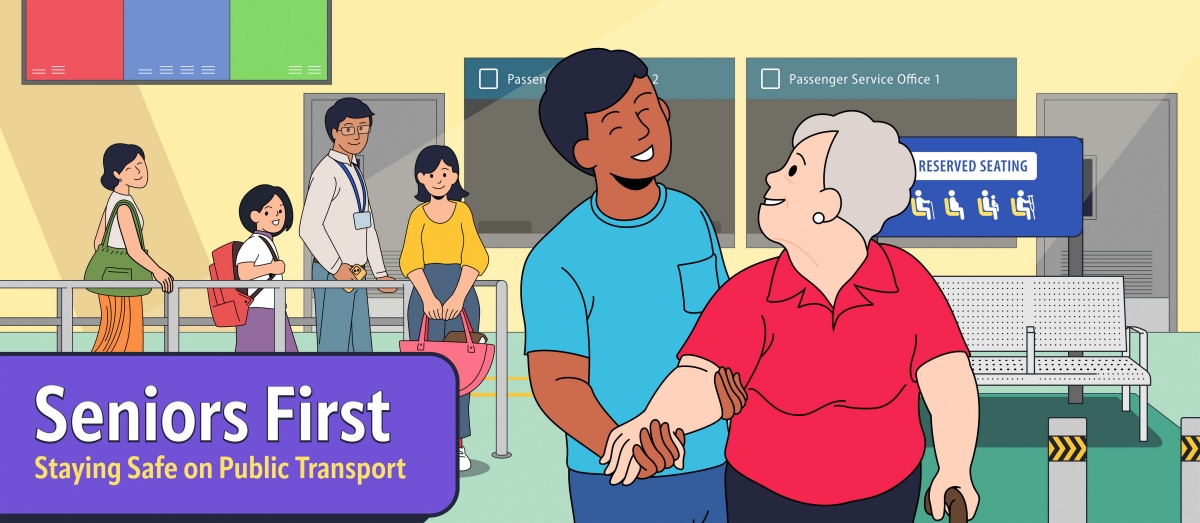
By 2030, a quarter of Singapore residents will be 65 years and above. With more senior-friendly features in our public transport and these safety tips, our silver generation can continue getting to places safely and affordably.
Age is just a number to us – commuters of all ages can be tapping their cards through our MRT gantries, no problem! Our public transport facilities are being fitted with more senior-friendly features to allow our silver generation to get around Singapore safely, conveniently and affordably.
In this guide we’ll cover:
- Inclusive and accessible features for seniors
- How to stay safe while riding on public transport
- Tips on healthy ageing
Our Public Transport Gonna Be, Gonna Be Golden
Public transport operators have been gradually making their facilities and services more thoughtful towards our seniors, with more initiatives on the way. Spotted any of these before?

#1: More Visual Aids for Wayfinding
Spotted murals on walls and floors at some of our public transport nodes? These help everyone find their way more easily to the correct bus berth or to nearby amenities. Look out for these nostalgic items in murals that also meant to help seniors jog their memory.

#2: Dementia Go-To Points
Our MRT and LRT stations, bus interchanges and integrated transport hubs are now Dementia Go-To Points. Friendly officers are ready to help those who are lost and unable to find their way home.

#3: Hearing Enhancement System
For seniors with hearing aids, the Hearing Enhancement System installed at all Passenger Service Centres along the Thomson-East Coast Line (TEL) significantly reduces background noise. Seniors with hearing aids can experience improved overall sound quality and speech clarity when communicating with public transport staff.
LTA plans to roll this out at all MRT stations in the future to help even more senior commuters!
#4: Senior-Friendly Buses
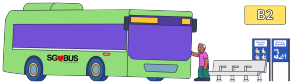
Safe and comfortable rides for seniors are a priority. Our public buses are equipped with dedicated priority seats, non-slip flooring, bus kneeling function to lower the bus body’s at bus stops, and grab bars to facilitate boarding and alighting.

#5: Helping Hand Scheme
On the back of the “Helping Hand” card*, caregivers can write down how others can support their senior parents during their commute. This card is a cue to station staff, bus captains and other passengers to keep an eye out for those who may need extra community support.
*Seniors can get a “Helping Hand” card from Passenger Service Centres at MRT stations and bus interchanges, and also SimplyGo Ticket Offices at Ang Mo Kio, Chinatown, Clementi, Tampines, Woodlands and Yishun MRT stations, and Ang Mo Kio, Bedok and Jurong East bus interchanges.
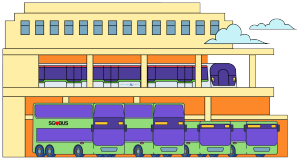
#6: Better Accessibility at Bus Interchanges
To help, seven existing bus interchanges are in the midst of getting enhanced with more accessible features. Seniors can feel more comfortable while waiting for the bus with features like priority queue zones, more seats, wheelchair-accessible toilets and tactile guided paths.
Be Careful, Don’t Be a Falling Star!
Preventing falls is a big concern for many of us with senior parents. Share in your family chatgroups our easy-as-ABC tips on how to stay safe and upright in MRT and LRT stations and at bus interchanges!
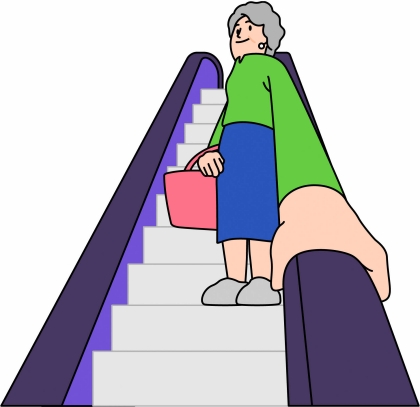
Alert and steady; hold the handrail
The escalator handrail is there for you – so hold tight for a safe ride!
Stay alert and put away mobile devices whenever you’re on the move.
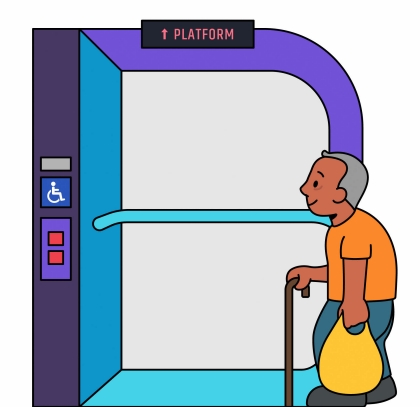
Bulky items or feeling unwell? Use the lift
Got your hands full or feeling under the weather? The lift is there for you!
Not only is it easier to navigate, it also keeps you steady and safe.
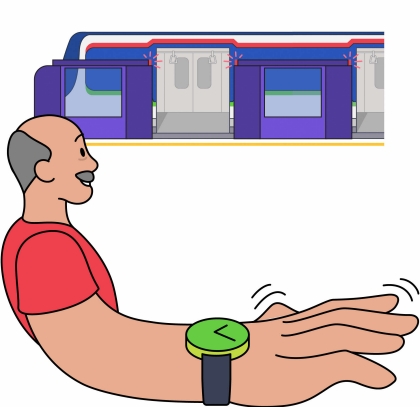
Calm down! Do not rush on escalators
We know it’s a bummer to miss a train, but please don’t rush on escalators to catch a train.
Take it easy - another train will arrive in just a few minutes. Better to reach your destination a bit later than not at all!
Here are more SAFETY tips to share with your loved ones on how they can stay safe on moving buses and trains!
 |
Stay on the lower deckThe lower deck is the best spot in the bus! No stairs to climb and you’ll be closer to the exit when it’s time to hop off at your stop. |
 |
Ask for a seat if you need itNo need to be paiseh (shy) – sitting down is safer for seniors. Take it easy and let someone give up their seat for you. |
 |
Firmly hold on to handrailsBuses can sometimes brake suddenly to avoid a collision. Always hold tight to the handrails and grab poles when standing or while moving towards an empty seat. |
 |
Enter and exit carefullyTake it slow and mind your step! |
 |
Travel light for a smooth rideAvoid carrying too many things when travelling on buses and MRT. Travelling light makes it easier for you to hold on to handrails and keep steady throughout your journey. A smooth ride starts with a light load. |
 |
You are in control!Take your time and follow these safety tips for a safe, smooth and steady ride. You’ve got this! |
Need help? Approach the Bus Captain or the station/interchange staff at Passenger Service Centres for assistance.
Senior Glow Up: Health Tips to Stay Active

Healthy ageing isn’t only about living longer; it’s also about being able to do day-to-day activities without aches and pains.
The more seniors move, the more health benefits they will get, say the experts from SingHealth. They recommend 150 to 300 minutes of moderate-intensity aerobic physical activity per week.
Help your parents to age well by encouraging them to:
- Make healthy lifestyle choices
- Pay close attention to what they eat and drink
- Engage in regular physical activities
- Maintain social connections
Read more about healthy ageing tips and best exercises for seniors on SingHealth’s HealthXchange.
It’s also important for the silver generation to stay mentally active – not just to continue navigating public transport independently – but for their overall wellness.
Besides the above tips which also help with maintaining a sharp mind, here are extra steps to keep our seniors alert, independent and happy.
- Quit smoking, if they haven’t
- Play games and puzzles
- Engage in hobbies
- Correct hearing loss, which is associated with memory loss
Learn more about staying mentally sharp on HealthXchange.
 3 Ways Our Commute is Getting Kinder
 6 Interesting Things About Our Integrated Transport Hub
 Seeking a spread worth cycling to? Here are six routes for you!
 What's Your Cycling Route Personality?
 Rejuvenating the Railway: NSEWL's Six Core Systems
 Move Lite Series: 10 Vibrant Spots Along the North-South Line
 6 Public Transport Hacks for the Busy Working Professional
 Tell me more about TEL4!
 Singapore's Road EMAS-gency Experts
 7 Ways to Look Sharp, Cycle Safe & Have a Smoother Ride
 Your 10 Best Bets for a Scenic Bus Cruise
 5 reasons the SRTC is breaking barriers to rail reliability
 Making a Mark in 3D
 Watt a Smart Street Light!
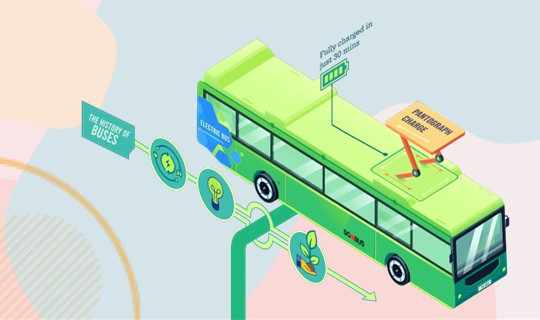 History of Buses
 (Re)Purpose for the People
 What's the Latest Buzz On Our Bus Stop Shelters?
 Placemaking: Hardware to Heartware
 Making a "PID-Stop" at one of our bus stops?
 Writing a New Chapter on Inclusivity
 TEL3 Hits the City: Get Fed, Get Fit and Feel Fab!
 Drones in the Zone
 What lies beneath: LTA's Digging Machine
 8 Facts to Charge Up You Knowledge About Electric Vehicles
 Stations, stations on the tracks, which is the greenest of them all?
 Take a brake! Explore these eight hidden gems on your bike
 Excuse me, are you a boring engineer?
 Look Ma, No Hands!
 10 Reasons the TEL is an Engine-nious Development
 Introducing Singapore’s Longest Transit Priority Corridor
 5 Fun Facts About Sustainability at LTA